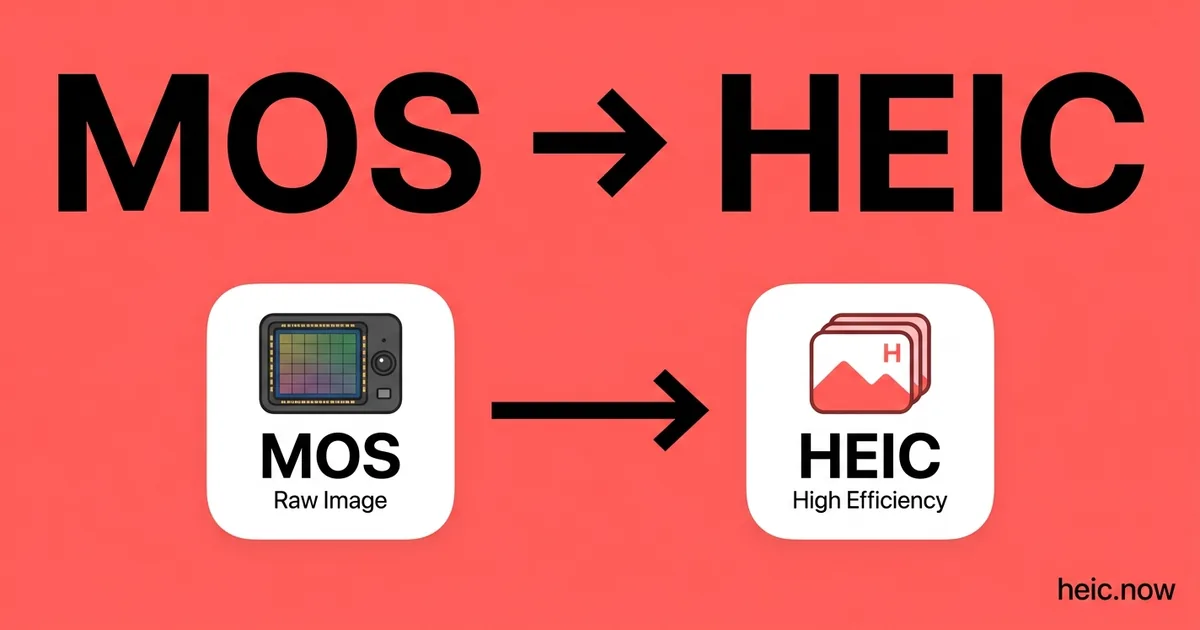
Convert Leaf MOS to HEIC Online
Develop Leaf/Mamiya RAW MOS files into HEIC images.


Drop your MOS file here
or click to select
How MOS to HEIC works
Upload MOS
Drag & drop or click to select your MOS file.
Choose Options
Adjust quality, size, or other output settings if needed.
Download HEIC
Click Convert and your HEIC file downloads instantly.
About MOS to HEIC conversion
MOS is the RAW format used by Mamiya Leaf medium-format digital backs - the Aptus, Aptus-II, Credo, and the Mamiya Leaf Credo line that mounted on Mamiya 645DF, Phase One XF, and Hasselblad H bodies. Resolutions run from 22MP (Aptus 22) up to 80MP (Credo 80). Commercial product photographers, automotive shooters, and luxury real-estate teams convert MOS to HEIC for client preview galleries: an 80MP frame that weighs 25MB as a quality JPG lands around 12-15MB as HEIC at the same visual quality, halving gallery load times and iPad storage on set.
Capture One Pro is the de facto MOS processor because Phase One acquired Leaf in 2014 and integrated per-back profiles deeply. The sensible pipeline is to develop in Capture One with lens cast correction applied, export a 16-bit TIFF for the retoucher, and generate HEIC previews for client review. HEIC's 10-bit color support is a genuine advantage at this end of the market: medium-format files are prized for tonal smoothness, and 8-bit JPG previews visibly band on studio backdrops and automotive paint gradients where 10-bit HEIC holds clean.
Client-side, HEIC previews shine in Apple-centric review workflows - art directors approving on iPads, gallery links opened on iPhones - where the format renders natively at half the bandwidth. The limits: PowerPoint on Windows, most web-based proofing platforms, and print bureaus expect JPG or TIFF, and Windows reviewers need the HEVC codec installed. Convert MOS to HEIC for the Apple review loop and keep HEIC to JPG handy for the deliverables that must travel further.
Where HEIC comes from
MOS is the long-running medium-format RAW container from Leaf Imaging, founded in 1992 in Israel and acquired by Mamiya, then later folded into Phase One in 2014. MOS files were originally written by Leaf's DCB scanning back in the 1990s and continued through the Aptus and Credo digital-back lines used with Mamiya 645 and Hasselblad V system bodies. Capture One Cultural Heritage remains the reference processor. MOS files are rare today but persist in the heritage-imaging, museum, and high-end product studios where Leaf and Mamiya backs are still working tools.
MOS vs HEIC at a glance
| MOS | HEIC | |
|---|---|---|
| Bit depth | 16-bit linear | 8 or 10-bit per channel |
| Compression | Lossless Leaf MOS container | HEVC intra (lossy or lossless) |
| Dynamic range | ~13 stops on Leaf Credo 80 | ~9 stops (more in 10-bit) |
| File size | 80-200 MB on 80 MP backs | 5-15 MB |
| Editing latitude | Very wide | Limited |
| White balance | Adjustable post-capture | Baked in |
Real-world workflow — Commercial product photographer runs client review from an iPad
- Tether a Leaf Credo 80 back on a Mamiya 645DF body straight into Capture One.
- Light a luxury watch on a turntable with two strobes and a black card.
- Capture twelve MOS frames at different focus distances for a focus-stack composite.
- Stack inside Helicon Focus and keep a 16-bit TIFF for the retouch pipeline.
- Export 10-bit HEIC review copies to the client's iPad — 200 MB frames become 10 MB flip-throughs.
Recommended conversion settings
| Use case | Settings |
|---|---|
| Client iPad review | sRGB HEIC, long edge 2048 px, quality 85 |
| Retoucher proof | 10-bit Display P3 HEIC, long edge 3000 px, quality 90 |
| Catalogue print proof | 10-bit HEIC, quality 95, native resolution |
| Archive alongside MOS | Skip HEIC — keep the MOS plus a single 16-bit TIFF |
| Quick selects gallery | sRGB HEIC, long edge 2048 px, quality 80 |
Where will your HEIC file open?
| Platform | MOS | HEIC |
|---|---|---|
| macOS Preview | ✗ | ✓ |
| Windows Photos | ✗ | ~ |
| iPhone Photos | ✗ | ✓ |
| Lightroom Classic | ~ | ✓ |
| Capture One (Leaf reference) | ✓ | ~ |
| Photoshop / Camera Raw | ~ | ✓ |
| Phase One IQ / Leaf Capture | ✓ | ✗ |
| Web browsers and social platforms | ✗ | ✗ |
When to convert MOS to HEIC
RAW files are the unprocessed sensor output of a digital camera - 20 to 100 MB each, unviewable without specialist software. Converting RAW to HEIC develops the file into a finished, viewable photo at a small fraction of the size, with automatic white balance and tone mapping applied. Compared with the traditional RAW-to-JPG step, HEIC output is roughly half the size again and supports 10-bit colour, preserving more of the tonal depth the RAW capture contains.
Photographers working in the Apple ecosystem use RAW-to-HEIC to build lightweight browsing libraries: the HEIC versions live in Apple Photos and sync through iCloud for review and sharing, while the RAW masters stay on an external archive. A season of shoots that would occupy hundreds of gigabytes as RAW previews fits comfortably in iCloud as HEIC.
Keep the RAW originals - They remain the editable master with full recovery latitude. And when delivering to clients or platforms whose HEIC support is unknown, convert to JPG instead; HEIC is the right choice for storage and Apple-native workflows, JPG for universal delivery.
MOS to HEIC tips
- Develop in Capture One Pro with lens cast correction (LCC) applied before converting - the HEIC bakes in whatever the export contains, magenta cast included.
- Use HEIC for iPad/iPhone client review loops - 10-bit color keeps backdrop and paint gradients smooth where 8-bit JPG previews band.
- Export 16-bit TIFF for retouchers and print - HEIC is a preview and delivery format, not a retouching intermediate.
- Strip back serial number and shoot date from EXIF before client delivery - HEIC preserves full metadata through conversion unless you remove it.
- For 80MP+ backs, resize to 8192px long edge on export before HEIC conversion - full-resolution previews waste bandwidth on any screen a client will actually use.
Formats involved
MOS – Leaf Camera RAW
HEIC – High Efficiency Image Container
MOS to HEIC — frequently asked questions
Related guides & articles
Maybe you wanted something else?
- Hasselblad medium-format equivalent → 3FR to HEIC
- Convert to DNG for archive safety → DNG to HEIC
- Generic RAW workflow → Generic RAW to HEIC
- Producing a printed catalogue → HEIC to PDF
Related conversions
 JPG → HEIC
 PNG → HEIC
 WebP → HEIC
 PDF → HEIC
 RAW → HEIC
 TIFF → HEIC
 BMP → HEIC
 SVG → HEIC
 GIF → HEIC
 HEIC → HEIC
Embed this tool on your website