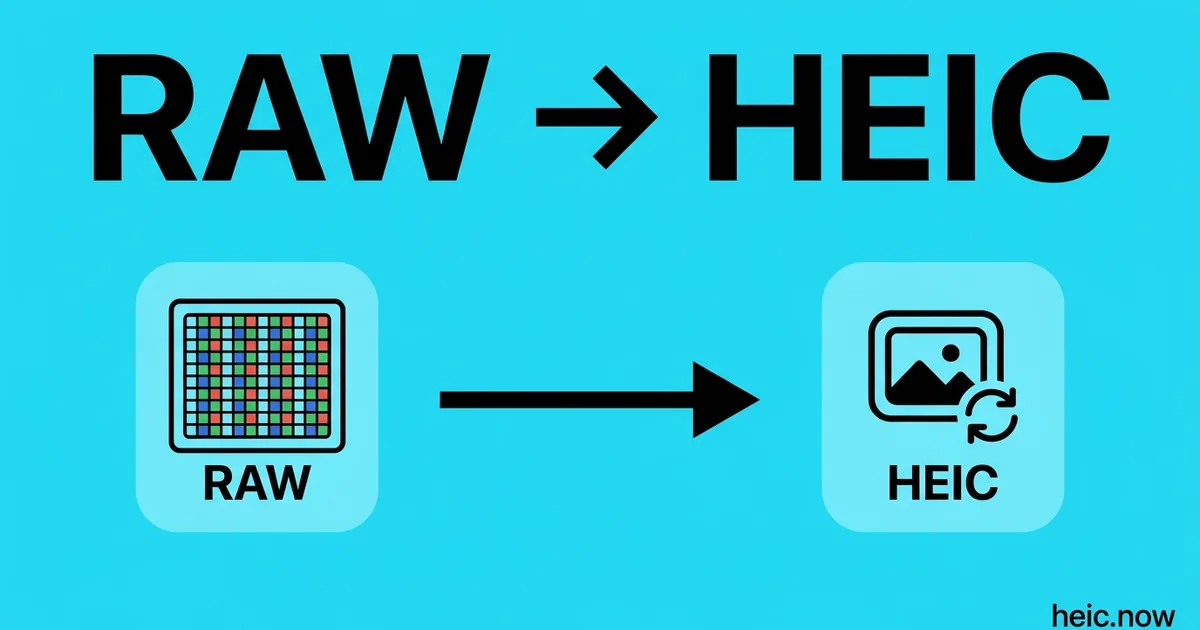
Convert RAW to HEIC Online
Develop RAW camera files into compact, Apple-friendly HEIC photos.


Drop your RAW file here
or click to select
How RAW to HEIC works
Upload RAW
Drag & drop or click to select your RAW file.
Choose Options
Adjust quality, size, or other output settings if needed.
Download HEIC
Click Convert and your HEIC file downloads instantly.
About RAW to HEIC conversion
Camera RAW formats (CR2, CR3, NEF, ARW, RAF, DNG, RW2, ORF, and others) store the unprocessed sensor data from your camera - Essentially everything the image sensor captured, before sharpening, noise reduction, white balance, and colour rendering are applied. This gives photographers maximum post-processing flexibility but requires specialised software to view and share.
Converting RAW to HEIC produces a finished image at roughly half the file size a JPG export would be - And because HEIC supports 10-bit colour, it retains more of the sensor's tonal range than 8-bit JPEG can. The conversion applies automatic white balance, tone curve, and basic colour rendering to produce a natural-looking result. For maximum creative control, professionals develop RAW files in Lightroom or Capture One with custom settings first.
RAW files are considerably larger than any delivery format: a 24 MP camera produces a RAW file of 25–40 MB versus a 2–6 MB HEIC. That makes RAW→HEIC an excellent archival play for Apple-ecosystem photographers - But check the destination first, since clients and labs on Windows or older software may need JPG instead.
Where HEIC comes from
RAW is not a single format - it's a category for camera-sensor data files like Canon CR2/CR3, Nikon NEF, Sony ARW, Fuji RAF, and Adobe's open DNG. The first widely shipped RAW format was Kodak's DCR in 1996 on the DCS 460 professional body. Adobe published DNG (Digital Negative) in 2004 as an attempt to unify the ecosystem under ISO 12234-2 / TIFF-EP. Despite DNG's promise, every camera maker still ships its own proprietary RAW, which is why Adobe Camera Raw and DxO PhotoLab maintain decoder libraries covering more than 800 distinct camera bodies as of 2025 - and why a 10-bit HEIC render is such an appealing universal archive for frames that don't justify keeping the full sensor dump.
RAW vs HEIC at a glance
| RAW | HEIC | |
|---|---|---|
| Compression | Lossless or visually lossless | Lossy HEVC / H.265 |
| Bit depth | 12-14 bit per channel | 10 bit per channel (vs JPG's 8) |
| Typical file size (24 MP photo) | 25-50 MB | 2-4 MB at Q90 |
| White balance editable post-capture | Yes (non-destructive) | No (baked in) |
| Best for | Editing master in Lightroom / Capture One | Space-efficient archive and Apple-device delivery |
| Universal viewer support | No (camera-specific) | Native on Apple; Windows needs codec |
Real-world workflow — Wedding photographer archives outtakes without burning terabytes
- Import 1,800 RAW files (Sony .ARW, Canon .CR3) into Lightroom Classic after the wedding - about 70 GB.
- Cull to 120 keepers that stay RAW as editing masters; the other 1,680 frames are outtakes worth keeping but not at 40 MB each.
- Convert the outtakes RAW to HEIC at Q90 full resolution - 10-bit output holds far more of the RAW's tonal range than an 8-bit JPG archive would.
- The outtake archive drops from about 65 GB to 6 GB and every frame still previews instantly in Apple Photos and Finder.
- Store the HEIC archive in cloud storage; deliverables to the couple later go out via HEIC to JPG.
Recommended conversion settings
| Use case | Settings |
|---|---|
| Outtake / B-roll archive | Q90, full resolution, 10-bit, keep EXIF |
| Same-day client preview | Q80, 2048 px long edge, sRGB, watermark |
| Apple Photos personal library | Q85, full resolution, preserve GPS + date |
| HDR-graded frames | Q90, 10-bit, wide-gamut P3 profile |
| Maximum-quality single frames | Q95, full resolution, embed all metadata |
Where will your HEIC file open?
| Platform | RAW | HEIC |
|---|---|---|
| macOS Preview | ✓ | ✓ |
| Windows Photos | ~ | ~ |
| Gmail (web) | ✗ | ~ |
| Outlook desktop | ✗ | ~ |
| iOS Photos | ~ | ✓ |
| Android Gallery | ~ | ~ |
| Adobe Photoshop / Lightroom | ✓ | ✓ |
| Chrome / Safari / Firefox | ✗ | ~ |
| Slack / Discord | ✗ | ✗ |
When to convert RAW to HEIC
RAW files are the unprocessed sensor output of a digital camera - 20 to 100 MB each, unviewable without specialist software. Converting RAW to HEIC develops the file into a finished, viewable photo at a small fraction of the size, with automatic white balance and tone mapping applied. Compared with the traditional RAW-to-JPG step, HEIC output is roughly half the size again and supports 10-bit colour, preserving more of the tonal depth the RAW capture contains.
Photographers working in the Apple ecosystem use RAW-to-HEIC to build lightweight browsing libraries: the HEIC versions live in Apple Photos and sync through iCloud for review and sharing, while the RAW masters stay on an external archive. A season of shoots that would occupy hundreds of gigabytes as RAW previews fits comfortably in iCloud as HEIC.
Keep the RAW originals - They remain the editable master with full recovery latitude. And when delivering to clients or platforms whose HEIC support is unknown, convert to JPG instead; HEIC is the right choice for storage and Apple-native workflows, JPG for universal delivery.
RAW to HEIC tips
- For the best tonal rendering, develop RAW files in Lightroom or Capture One with your preferred colour grading before converting - The automatic conversion applies sensible defaults but won't match custom adjustments.
- Use quality 85–90% for RAW-to-HEIC conversion - HEVC is efficient enough that higher settings add little visible quality.
- Keep your original RAW files as permanent archives even after converting - RAW data cannot be recreated from a HEIC.
- If the output is for clients, print labs, or mixed audiences, consider JPG instead - Many recipients can't open HEIC without extra codecs.
Related tools
Formats involved
RAW – RAW Camera Image
HEIC – High Efficiency Image Container
RAW to HEIC — frequently asked questions
Related guides & articles
Maybe you wanted something else?
- For Canon RAW specifically → CR2 to HEIC
- For Nikon RAW specifically → NEF to HEIC
- For Sony RAW specifically → ARW to HEIC
- If clients need universal files → HEIC to JPG for delivery
Related conversions
 JPG → HEIC
 PNG → HEIC
 WebP → HEIC
 PDF → HEIC
 TIFF → HEIC
 BMP → HEIC
 SVG → HEIC
 GIF → HEIC
 HEIC → HEIC
Embed this tool on your website