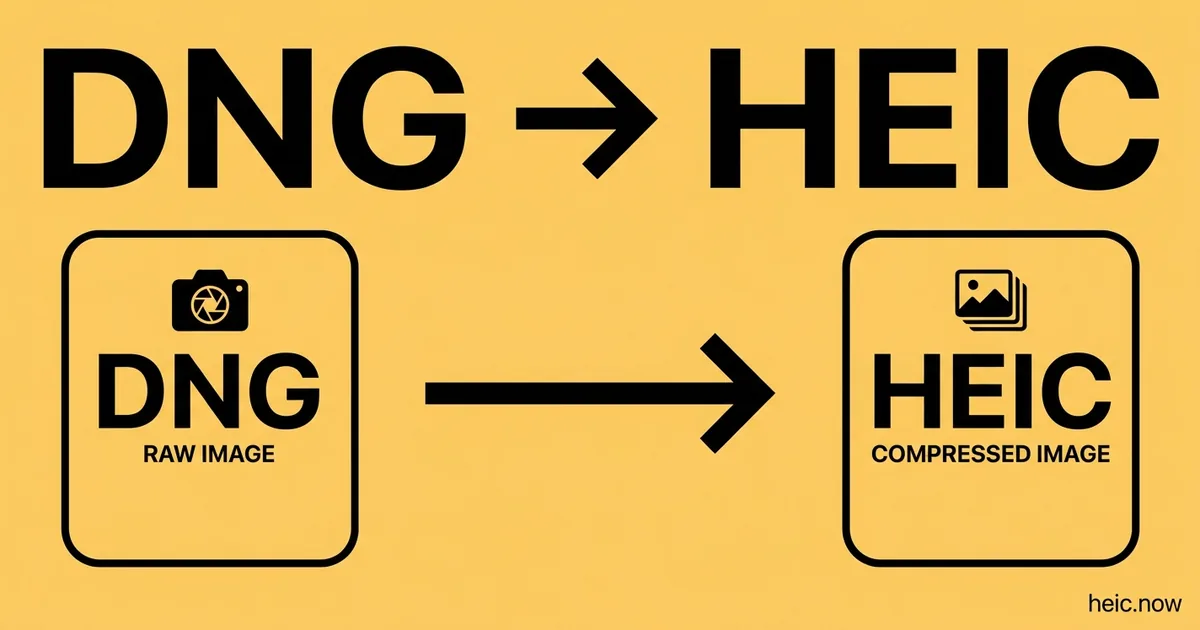
Convert DNG to HEIC Online
Develop Adobe Digital Negative DNG files into compact HEIC photos.


Drop your DNG file here
or click to select
How DNG to HEIC works
Upload DNG
Drag & drop or click to select your DNG file.
Choose Options
Adjust quality, size, or other output settings if needed.
Download HEIC
Click Convert and your HEIC file downloads instantly.
About DNG to HEIC conversion
DNG (Digital Negative) is Adobe's open RAW format, introduced in 2004 as a vendor-neutral alternative to the proprietary formats that every camera-maker invented independently. Pentax, Leica, Sigma, and Hasselblad ship DNG natively; almost every other camera's raw file can be converted to DNG using Adobe's free DNG Converter. iPhones since 2016 also write DNG when shooting in ProRAW mode.
That last source makes DNG-to-HEIC a particularly natural conversion: an iPhone ProRAW capture is a 40–60 MB DNG, and converting it to HEIC brings it back to the compact format the phone would have produced in standard mode — a 2–5 MB file that slots straight into Apple Photos, with the developed look baked in. Lightroom archivists get the same benefit: a browsable, storage-efficient Apple-native library derived from their DNG masters.
The conversion applies a full RAW-processing pipeline: demosaicing, white balance, tone curve, and optional lens-correction metadata. DNG carries enough information to reproduce the original camera's intent, and HEIC's 10-bit colour support preserves noticeably more of the raw file's tonal range than an 8-bit JPG export would.
Where HEIC comes from
Adobe introduced DNG (Digital Negative) in September 2004 as an openly documented, royalty-free RAW container, hoping to end the format fragmentation across camera makers. Pentax, Leica, Ricoh, Sigma (for some bodies), Hasselblad, and Apple's iPhone ProRAW write DNG natively, and Adobe's DNG Converter can repackage almost any proprietary RAW. The format is based on TIFF/EP, supports linear and lossy encodings, and is the only RAW container with an ISO standard reference. Current Leica Q3, M11, Pentax K-3 III, and Sigma fp bodies all ship DNG straight from the card.
DNG vs HEIC at a glance
| DNG | HEIC | |
|---|---|---|
| Bit depth | Typically 12 or 14-bit linear | 8 or 10-bit per channel |
| Compression | Lossless or optional lossy DNG | HEVC intra (lossy or lossless) |
| Dynamic range | ~12-14 stops depending on sensor | ~9 stops (more in 10-bit) |
| File size | 20-80 MB depending on source | 2-6 MB |
| Editing latitude | Wide and openly documented | Limited |
| White balance | Adjustable post-capture | Baked in |
Real-world workflow — Real-estate shooter builds an agent-friendly iPhone gallery
- Capture interiors on a Pentax K-1 II or Leica Q3 that writes DNG natively.
- Import to Lightroom, apply lens corrections, and balance window pulls against tungsten interiors.
- Sync settings across the bracketed set and pick the cleanest blended frame.
- Export via the DNG to HEIC converter at long edge 2048 px, quality 82 — half the size of JPGs.
- Drop the set into a shared iCloud folder the agent flips through on an iPhone during showings.
Recommended conversion settings
| Use case | Settings |
|---|---|
| Agent iPhone gallery | sRGB HEIC, long edge 2048 px, quality 82 |
| Interior detail set | sRGB HEIC, quality 88, long edge 3000 px |
| Web-bound derivative | sRGB HEIC, long edge 2048 px, quality 78 |
| Wide-gamut master proof | 10-bit Display P3 HEIC, quality 95, native resolution |
| ProRAW phone workflow | Display P3 HEIC, quality 85, long edge 2048 px |
Where will your HEIC file open?
| Platform | DNG | HEIC |
|---|---|---|
| macOS Preview | ✓ | ✓ |
| Windows Photos | ~ | ~ |
| iPhone Photos (Apple ProRAW) | ✓ | ✓ |
| Lightroom Classic | ✓ | ✓ |
| Capture One | ✓ | ~ |
| Photoshop / Camera Raw | ✓ | ✓ |
| Adobe DNG Converter | ✓ | ~ |
| Web browsers and social platforms | ✗ | ✗ |
When to convert DNG to HEIC
RAW files are the unprocessed sensor output of a digital camera - 20 to 100 MB each, unviewable without specialist software. Converting RAW to HEIC develops the file into a finished, viewable photo at a small fraction of the size, with automatic white balance and tone mapping applied. Compared with the traditional RAW-to-JPG step, HEIC output is roughly half the size again and supports 10-bit colour, preserving more of the tonal depth the RAW capture contains.
Photographers working in the Apple ecosystem use RAW-to-HEIC to build lightweight browsing libraries: the HEIC versions live in Apple Photos and sync through iCloud for review and sharing, while the RAW masters stay on an external archive. A season of shoots that would occupy hundreds of gigabytes as RAW previews fits comfortably in iCloud as HEIC.
Keep the RAW originals - They remain the editable master with full recovery latitude. And when delivering to clients or platforms whose HEIC support is unknown, convert to JPG instead; HEIC is the right choice for storage and Apple-native workflows, JPG for universal delivery.
DNG to HEIC tips
- If your DNG came from an iPhone in ProRAW mode, expect a dramatic size drop: a 40–60 MB ProRAW DNG becomes a 2–5 MB HEIC at quality 90.
- DNG files from Adobe DNG Converter (re-wrapped from CR2/NEF/ARW/RAF) carry the original camera's metadata. The HEIC output matches what the source camera would have produced.
- For full RAW reprocessing control (highlight recovery, noise reduction), develop the DNG in Lightroom first and convert the export — the web pipeline applies sensible defaults, not custom edits.
- If you shoot Apple ProRAW, the DNG already includes Apple's Deep Fusion processing. The HEIC will reflect that — you don't need to add extra sharpening downstream.
- Keep the DNG as your master — the HEIC is a finished, lossy rendering and can't be re-developed later.
Related tools
Formats involved
DNG – Digital Negative (Adobe)
HEIC – High Efficiency Image Container
DNG to HEIC — frequently asked questions
Related guides & articles
Maybe you wanted something else?
- Source was a proprietary RAW first → Generic RAW to HEIC
- Need a 16-bit master from the HEIC → HEIC to TIFF
- Bundling a listing brochure → HEIC to PDF
- Trimming final HEIC files further → Compress HEIC
Related conversions
 JPG → HEIC
 PNG → HEIC
 WebP → HEIC
 PDF → HEIC
 RAW → HEIC
 TIFF → HEIC
 BMP → HEIC
 SVG → HEIC
 GIF → HEIC
 HEIC → HEIC
Embed this tool on your website