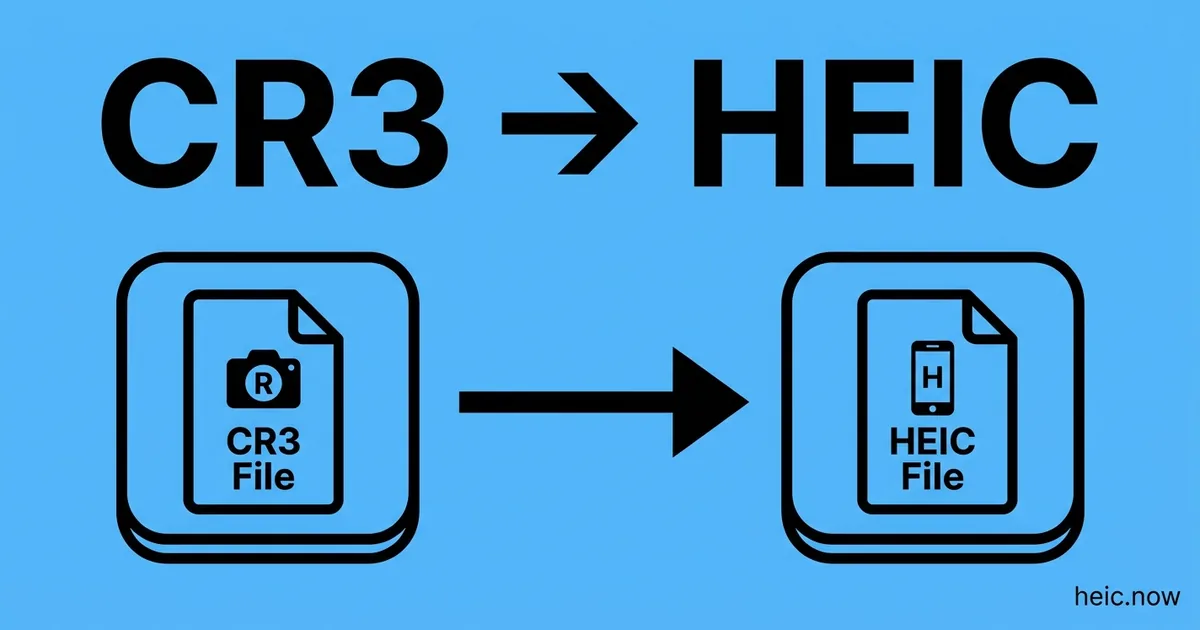
Convert Canon CR3 to HEIC Online
Develop Canon's CR3 RAW format into compact HEIC photos.


Drop your CR3 file here
or click to select
How CR3 to HEIC works
Upload CR3
Drag & drop or click to select your CR3 file.
Choose Options
Adjust quality, size, or other output settings if needed.
Download HEIC
Click Convert and your HEIC file downloads instantly.
About CR3 to HEIC conversion
CR3 is Canon's newer RAW container introduced with the EOS M50 and now standard across the R5, R6, R3, R7, R10, and 1D X Mark III. The format wraps CR-RAW image data in an ISO base-media (MP4-style) box structure and supports Canon's C-RAW compressed variant, which can shrink a 45MP R5 file from 55MB to about 25MB. Converting developed CR3 frames to HEIC is the space-efficient way to keep viewable copies of a whole shoot: HEIC files run 40-50% smaller than an equivalent-quality JPEG, which matters when a single R3 burst session fills a 512GB CFexpress card.
HEIC is a natural landing format for Canon shooters who live in the Apple ecosystem. iPhones and iPads have used HEIC as their default camera format since iOS 11, so Photos, iCloud, AirDrop, and Messages all treat converted CR3 files as first-class citizens - thumbnails, face recognition, and search work exactly as they do for iPhone captures. Because HEIC supports 10-bit color, a CR3-to-HEIC derivative also holds onto more of the 14-bit sensor file's tonal gradation than an 8-bit JPG would, which shows in smooth skies and studio backdrops where JPG can band.
The trade-off is reach: agency wires (AP, Reuters), MLS portals, and most stock libraries still demand JPG, and Windows machines need the HEVC Video Extensions codec before Explorer will even thumbnail a HEIC. So the sensible split is HEIC for your own library, iPad culling sessions, and iCloud archives, and JPG for external delivery. Batch-convert a card of CR3 files to HEIC for the personal archive, keep the CR3 originals as masters, and export JPG separately only for the handful of frames that go out the door.
Where HEIC comes from
CR3 arrived with the Canon EOS M50 in early 2018, replacing the long-running CR2 format that had shipped since the EOS 350D in 2005. The container is built on Apple's ISOBMFF — the same base used by HEIF and HEIC — which let Canon add Dual Pixel data, C-RAW lossy compression, and HEIF still capture inside one consistent file structure, and makes CR3-to-HEIC a conversion between structural cousins. The mirrorless R-series adopted CR3 as a system standard, and the professional EOS R1, R5 II, R3, R5, R6 II, and the high-end 1D X Mark III DSLR all write CR3. Canon's Digital Photo Professional remains the reference decoder.
CR3 vs HEIC at a glance
| CR3 | HEIC | |
|---|---|---|
| Bit depth | 14-bit, with C-RAW lossy option | 8 or 10-bit per channel |
| Compression | Lossless or C-RAW lossy | HEVC intra (lossy or lossless) |
| Dynamic range | ~14 stops on R5 II / R1 | ~9 stops (more in 10-bit) |
| File size | 30-70 MB depending on body | 3-7 MB |
| Editing latitude | Wide | Limited |
| White balance | Adjustable post-capture | Baked in |
Real-world workflow — Wedding lead posts same-night sneak peeks to the couple's shared album
- Capture the ceremony on a Canon R5 II writing CR3 plus small JPG to dual cards.
- Pull the preview card straight into Photo Mechanic at the reception venue for a fast cull.
- Apply a custom Lightroom preset to thirty keepers, fine-tuning skin tones.
- Export HEICs at long edge 2048 px and quality 80 — Apple-native for the couple's iPhones.
- Add them to the shared iCloud album the same night; reserve the CR3s for the full album edit.
Recommended conversion settings
| Use case | Settings |
|---|---|
| Wedding sneak peeks | sRGB HEIC, long edge 2048 px, quality 80 |
| Album master proof | 10-bit Display P3 HEIC, quality 95, native resolution |
| Client selects gallery | sRGB HEIC, quality 82, long edge 2400 px |
| iCloud shared album | sRGB HEIC, long edge 2048 px, quality 78 |
| Social vertical | sRGB HEIC, 1080 x 1350, quality 80 |
Where will your HEIC file open?
| Platform | CR3 | HEIC |
|---|---|---|
| macOS Preview | ~ | ✓ |
| Windows Photos | ~ | ~ |
| iPhone Photos | ✗ | ✓ |
| Lightroom Classic | ✓ | ✓ |
| Capture One | ✓ | ~ |
| Photoshop / Camera Raw | ✓ | ✓ |
| Canon Digital Photo Professional | ✓ | ~ |
| Web browsers and social platforms | ✗ | ✗ |
When to convert CR3 to HEIC
RAW files are the unprocessed sensor output of a digital camera - 20 to 100 MB each, unviewable without specialist software. Converting RAW to HEIC develops the file into a finished, viewable photo at a small fraction of the size, with automatic white balance and tone mapping applied. Compared with the traditional RAW-to-JPG step, HEIC output is roughly half the size again and supports 10-bit colour, preserving more of the tonal depth the RAW capture contains.
Photographers working in the Apple ecosystem use RAW-to-HEIC to build lightweight browsing libraries: the HEIC versions live in Apple Photos and sync through iCloud for review and sharing, while the RAW masters stay on an external archive. A season of shoots that would occupy hundreds of gigabytes as RAW previews fits comfortably in iCloud as HEIC.
Keep the RAW originals - They remain the editable master with full recovery latitude. And when delivering to clients or platforms whose HEIC support is unknown, convert to JPG instead; HEIC is the right choice for storage and Apple-native workflows, JPG for universal delivery.
CR3 to HEIC tips
- Shoot C-RAW instead of full CR3 if your end product is a HEIC library anyway - the quality difference is invisible at normal viewing sizes and saves 40-50% card space before conversion even starts.
- Use Canon DPP4 (free with your camera) to develop the CR3 with your in-camera Picture Style first if color matters - then convert the developed result to HEIC for storage.
- HEIC's 10-bit support preserves smooth gradients better than JPG - prefer it for sunset, studio-backdrop, and astro frames where 8-bit banding is most visible.
- Keep the CR3 originals as masters - HEIC is a viewing derivative, and re-editing white balance or recovering highlights still requires the 14-bit RAW data.
- Strip GPS metadata before sharing converted HEIC files - R5 bodies embed precise location, and HEIC carries full EXIF/GPS through conversion unless you remove it.
Related tools
Formats involved
CR3 – Canon RAW Version 3
HEIC – High Efficiency Image Container
CR3 to HEIC — frequently asked questions
Related guides & articles
Maybe you wanted something else?
- Older Canon body shooting CR2 → CR2 to HEIC
- Pre-2004 Canon with CRW → CRW to HEIC
- Generic Canon RAW pipeline → Generic RAW to HEIC
- Compressing the same-night delivery → Compress HEIC
Related conversions
 JPG → HEIC
 PNG → HEIC
 WebP → HEIC
 PDF → HEIC
 RAW → HEIC
 TIFF → HEIC
 BMP → HEIC
 SVG → HEIC
 GIF → HEIC
 CR2 → HEIC
 HEIC → HEIC
Embed this tool on your website